Do you trust AI? Thought so. With Holobiont you get micronutrient details, sources you can inspect, and reference ranges grounded in verified sources. Turn meal photos into nutrition data and lab questions into cited answers, with the evidence behind each result.
Reference-present nutrients detected. Amounts are still estimates.
Sources you can verify
100% vs 0%
Answers with source citations you can inspect.
Correct reference ranges
70.7% vs 0.7%
Biomarker answers matching the library’s range in automatic checks.
Preferred by the reviewer
75.3% vs 22%
Answers preferred in the blinded, two-order review.
Holobiont vs a plain GPT 6 prompt in our published benchmark. Explore the results
Pay per call, no monthly fee
Database matches and estimates clearly labelled
Powers meal recognition in HoloHabits
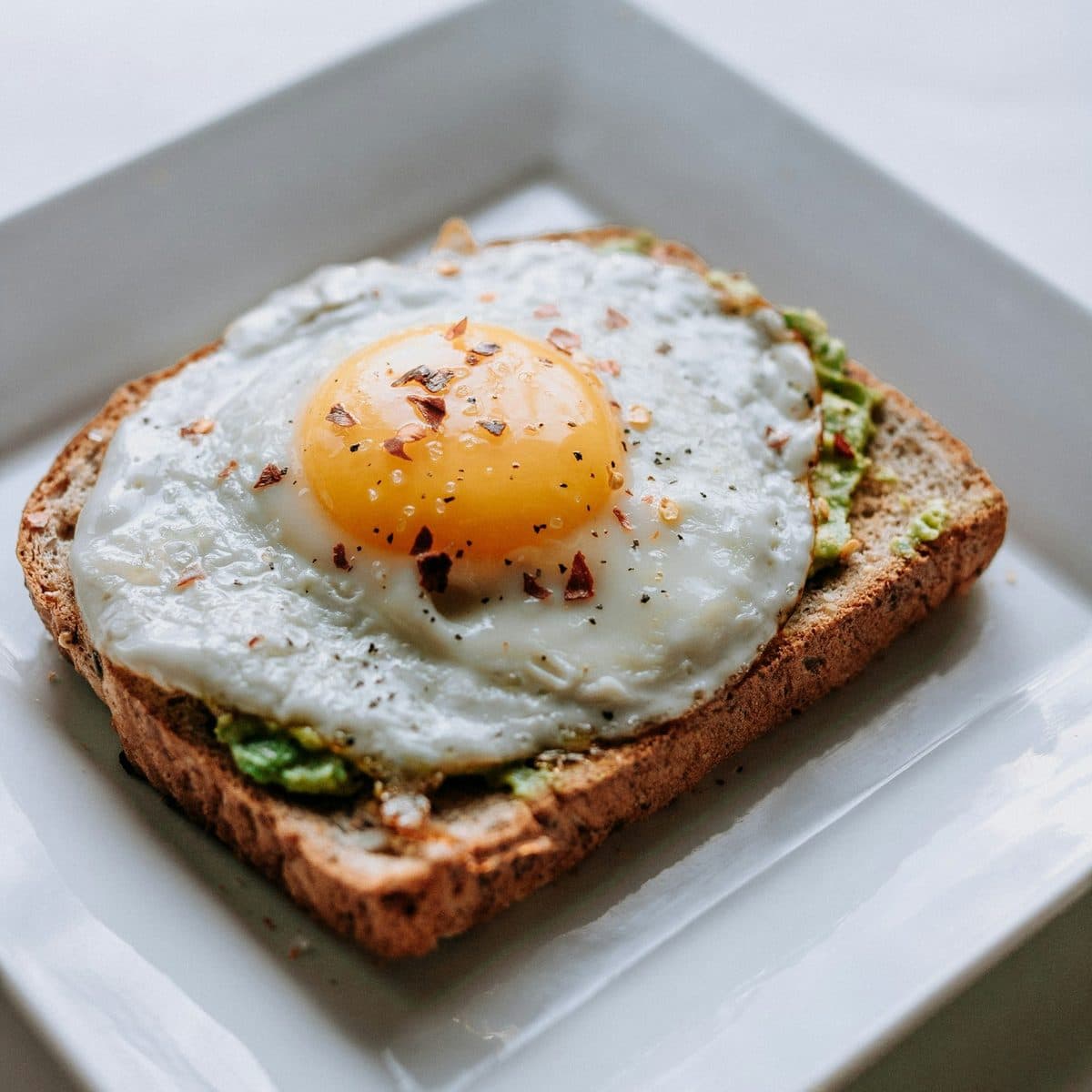
fried egg50 g
mashed avocado40 g
toasted whole grain bread45 g
Total350 kcal
01 — What you can build
Four capabilities, one API key.
Each one is a single request. You send what your users have; the API returns structured, grounded data you can show, store or reason about.
Meal photos into nutrition
Photo in, dish and items out: estimated grams per item, calories and macros, micronutrients, hidden oils and dressings, a confidence score and how much of the plate is backed by the nutrition database.
Items the database cannot match are marked as estimates, so your app always knows what it is showing.
Biomarker questions, answered with sources
Ask about a lab value in plain language. The answer is grounded in your biomarker library and knowledge base and comes back with numbered citations, follow-up questions and the tokens used.
Conversations persist, so a coach can continue where the user left off.
Product pages into supplement records
Point it at a product page or a whole Shopify or WooCommerce store. It reads the store data, decides what is a supplement, fills ingredients, dosage, safety and pharmacology, and attaches citations.
A full catalog of 500 products imports in one call.
Evidence on demand
Ask for references on a question, a supplement or a claim. The API searches academic papers, then judges each one for relevance (0–3) and for whether it supports or contradicts the claim.
Literature search itself is a plain lookup; judging the papers is the AI part.
02 — See it work
One photo. Every number explained.
This is the real response for the photo on the left, replayed step by step. Nothing here is mocked: the items, grams, confidence, nutrients and the low-confidence oil are what the API returned.
Avocado Toast with Fried Egg
A slice of toasted whole grain bread topped with mashed avocado and a sunny-side-up fried egg, seasoned with red pepper flakes and black pepper.
fried egg
one large egg
50 g95 %
mashed avocado
a layer of mashed avocado
40 g85 %
toasted whole grain bread
one thick slice of bread
45 g90 %
cooking oilLikely hidden
oil used for frying the egg
7 g30 %
Micronutrients
Vitamin D4.98 mcg
Vitamin B120.73 mcg
Folate (B9)50 mcg
Vitamin E2.41 mg
Vitamin K3.23 mcg
Choline169 mg
Iron2.2 mg
Magnesium41.1 mg
Potassium323 mg
Zinc1.44 mg
Selenium34.7 mcg
Omega-30.78 g
100% of the plate’s weight matched in the nutrition database · confidence 90 %
Assumed oil was used to fry the egg
Estimated bread weight based on standard thick-cut slice
Assumed avocado is plain mashed without added mayo or cream
03 — Case study
HOLOHABITS
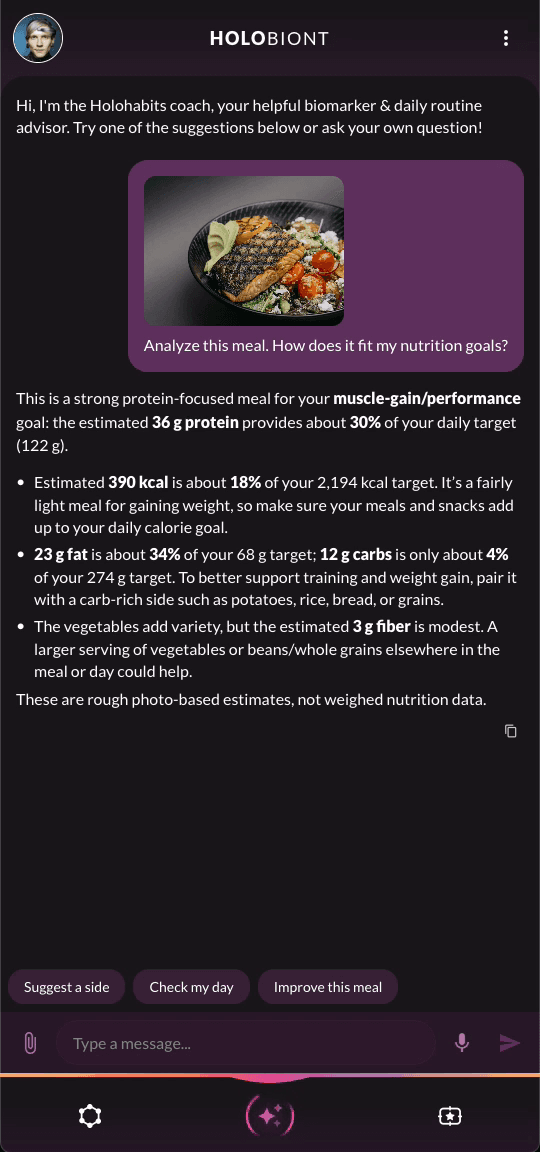
A photo becomes a food log entry in the HoloHabits app.
HoloHabits is a home nutrition-testing platform: a finger-prick biomarker panel, an app and a coach that reads the results. When a user photographs a meal in the coach, the app sends it to the Holobiont API and shows what comes back.
01
One request per photo
The app posts the photo to /food/analyze with the user’s note and locale. The structured result maps straight onto its meal view.
02
Honest about uncertainty
Each item carries a confidence and whether its nutrients come from the database or an estimate. HoloHabits shows both, and lets the user correct portions.
03
Same data, next question
The logged meal feeds the coach, which relates it to the user’s own biomarkers and daily targets.
GPT 6 vs. Gemini 4 vs. Holobiont AI on the same meal photos and biomarker questions. Compare food recognition, nutrition estimates, reference ranges and cited answers. Choose a comparator to see the paired scores.
Overall score
Every compared measure of both benchmarks, meal photos and biomarker questions, scaled to 0–100 and averaged with equal weight.
Compare with
Holobiont AI64.8 / 100
a plain GPT 6 prompt40.2 / 100
Holobiont scores 61.2 % higher in this comparison.
Every measure, scored 0–100Each row compares the two arms on the same measure. Sorted by the API’s lead.
Holobiont AI 64.8a plain GPT 6 prompt 40.2
Dashed markers show the averages. Each connected pair is one measure. Better score.
Answers with source citations: 100 vs 0. Correct reference range stated: 70.7 vs 0.7. Review: cites sources: 68.4 vs 0. Answers the reviewer preferred: 75.3 vs 22. Micronutrients in the meal reported: 95.6 vs 50.3. Review: range interpretation: 74.4 vs 30.2. Reviewer score: 67.2 vs 25. Value placed correctly: 93.8 vs 74.8. Listed items that were really there: 74.5 vs 58.3. Review: actionable, safe advice: 59.2 vs 44.6. Ingredients on the plate recognised: 63.1 vs 48.6. Carbohydrate error: 55.2 vs 44.8. Micronutrient amount error: 55.4 vs 51.7. Fat error: 50.7 vs 49.3. Calorie error, relative: 64.2 vs 64.4. Portion weight error per item: 49.8 vs 50.2. Whole-plate weight error: 49.8 vs 50.2. Protein error: 49.1 vs 50.9. Plates within 20 % of weighed calories: 31.7 vs 35. Calorie error per plate: 47.7 vs 52.3.
Across 20 measures: ahead on 12, within noise on 7, behind on 1.
How the score is calculated
Every compared measure scaled to 0–100 (percentages as they are, errors as 100 minus the error, reviewer scores ×20, gram and kcal errors relative to the other arm) and averaged with equal weight. Ahead and behind count only differences whose 95 % interval excludes zero.
Measures where Holobiont leads or adds data
Carbohydrate error8.1 g vs 10 g
Ingredients on the plate recognised63 % vs 49 %
Listed items that were really there75 % vs 58 %
Micronutrients in the meal reported96 % vs 50 %
Fibre, saturated fat, sodium and sugar on every plate100 % · only the API
Portion weight backed by the nutrition database85 % · only the API
n = 300 weighed plates
The same weighed meals, compared for ingredient recognition, portion weights, calories, macros and micronutrients. Nutrient estimates depend on correctly identifying the food and its portion. All measured results are shown below.
All meal-photo measurements depend on the vision model correctly identifying the foods and estimating portions in the picture. Missed or misidentified ingredients affect calories, protein, fat, carbohydrates and micronutrients, even when nutrient values come from a database.
Against a plain Gemini 4 prompt: Holobiont is significantly ahead on listed items that were really on the plate and micronutrients present in the meal that were reported.
Holobiont AI a plain GPT 6 prompt a plain Gemini 4 prompt
Plates with fibre, saturated fat, sodium and sugar
Holobiont AIHolobiont AI
Holobiont AI: 100 %
The plain prompt was asked for calories, protein, fat and carbohydrates; the API returns the full panel on every plate
300 weighed cafeteria plates photographed from above, each with its measured calories, protein, fat and carbohydrates and a list of weighed ingredients. Dataset: Nutrition5k (CC BY 4.0).
GPT 6 vs. Gemini 4 vs. Holobiont AI on reference ranges, result interpretation and cited answers. The worked example below shows a plain GPT 6 prompt and Holobiont AI, unedited. The complete results compare the same questions across these systems.
The question
Is a Oleic acid C18:1 n-9 cis of 120 umol/L something to worry about?
a plain GPT 6 prompt
no sources
Reviewer score 0.33 / 5
A value of oleic acid (C18:1 n‑9 cis) of 120 µmol/L isn’t enough on its own to say whether there’s a problem. Interpretation depends on the lab’s reference range, the type of test, and the rest of the fatty-acid panel and your health context. Oleic acid is a common fatty acid in foods and in the body; an isolated result is not usually a diagnosis. Check the reference range printed on your report and ask the clinician who ordered the test to interpret it alongside the other results. If you share the range and the reason the test was done (and any flagged values), I can help explain what the report says.
Holobiont AI
6 sources
Reviewer score 4.67 / 5
Interpretation
120 µmol/L is below the organization’s reference range of 300–2,300 µmol/L for oleic acid C18:1 n-9 cis. That makes it a low result, but one fatty-acid measurement alone does not establish a health problem. Its meaning depends on the lab’s method, whether the sample was fasting, and the rest of your fatty-acid profile. Oleic acid is a monounsaturated fat found in olive oil, nuts, and seeds; it is also part of cell membranes. A low level can reflect lower intake or differences in absorption or metabolism. The result is not, by itself, a direct measure of energy, recovery, cognition, or cardiovascular risk.
Practical next steps
Check the report for its own reference interval and confirm units and sample conditions; compare this result with other fatty acids, especially omega-3s and essential fatty acids.
If your usual diet is low in unsaturated fats, include foods such as extra-virgin olive oil, avocado, almonds, hazelnuts, and olives as part of balanced meals. Olive oil is a rich source of oleic acid.[1][3]
Avoid trying to “correct” the number with a high-dose supplement based on this result alone. Consider repeating the test under comparable conditions if it remains relevant to your goals.
The supplied research does not establish a clinical cutoff at which an oleic acid value of 120 becomes dangerous. One observational study found associations between several fatty acids, including oleic acid, and diabetes risk; it does not show that a low oleic-acid result causes diabetes or predicts an individual’s risk.[4] Bottom line: it is below the listed reference range and worth reviewing in the context of the complete panel and your diet, but the number alone is not a reason to assume something is seriously wrong.
References
[1][2] Biohacker's Nutrition Guide
[3] Longevity Leap
[4] Qureshi et al. (2019). Risk of diabetes associated with fatty acids in the de novo lipogenesis pathway is independent of… PMID 31543975
[5] Sebastian et al. (2017). Pro-inflammatory fatty acid profile and colorectal cancer risk: A Mendelian randomisation analysis. European Journal of Cancer. PMID 28829991
[6] Karina et al. (2019). Fatty acids, epigenetic mechanisms and chronic diseases: a systematic review. Lipids in Health and Disease. PMID 31615571
Overall score
Every compared measure of this benchmark scaled to 0–100 and averaged with equal weight.
Compare with
Holobiont AI76.1 / 100
a plain GPT 6 prompt24.7 / 100
Holobiont scores 208.1 % higher in this comparison.
Every measure, scored 0–100Each row compares the two arms on the same measure. Sorted by the API’s lead.
Holobiont AI 76.1a plain GPT 6 prompt 24.7
Dashed markers show the averages. Each connected pair is one measure. Better score.
Answers with source citations: 100 vs 0. Correct reference range stated: 70.7 vs 0.7. Review: cites sources: 68.4 vs 0. Answers the reviewer preferred: 75.3 vs 22. Review: range interpretation: 74.4 vs 30.2. Reviewer score: 67.2 vs 25. Value placed correctly: 93.8 vs 74.8. Review: actionable, safe advice: 59.2 vs 44.6.
Across 8 measures: ahead on 8, within noise on 0, behind on 0.
How the score is calculated
Every compared measure scaled to 0–100 (percentages as they are, errors as 100 minus the error, reviewer scores ×20, gram and kcal errors relative to the other arm) and averaged with equal weight. Ahead and behind count only differences whose 95 % interval excludes zero.
Measures where Holobiont leads or adds data
Correct reference range stated71 % vs 0.7 %
Value placed correctly94 % vs 75 %
Reviewer score3.36/5 vs 1.25/5
Answers the reviewer preferred75 % vs 22 %
Answers citing peer-reviewed papers76 % · only the API
Answers with source citations100 % vs 0 %
n = 300 questions
Against a plain Gemini 4 prompt: Holobiont is significantly ahead on answers that state the correct reference range, answer quality, blinded review, review: range interpretation, review: cites sources, questions where the reviewer preferred the answer and answers with source citations.
Holobiont AI a plain GPT 6 prompt a plain Gemini 4 prompt
Structured source citations or explicit source URLs, checked identically for both arms. Named sources without links are assessed by the blinded reviewer.
Against a plain Gemini 4 prompt: Holobiont ahead, significant · difference +100 [100, 100]
One credit is 0.001 €. Every call is priced in credits: a meal photo analysis is about 13, a chat answer 15 to 30, a nutrition lookup 6. AI calls are charged for what they actually use plus a small platform share; refused requests cost nothing.
When do I get the 5 € welcome credit?
After setting up your company, describe in a few sentences what you plan to build (a project website is optional). We review it, usually within a working day, and email you when the credit is on your balance. If you do not want to wait, skip the step and buy credits right away.
Do credits expire? Is there a subscription?
No and no. There is one pay-as-you-go plan. Credits stay on your company’s balance until used, and you can turn on auto-recharge so work never pauses.
How fast is a meal photo analysis?
Recognition plus database grounding typically takes a few seconds. The response is complete JSON, so you can show the result as soon as it arrives.
What happens with a photo that is not food?
The API answers 422 with a code: NOT_FOOD, MEDICATION or INVALID_IMAGE. You are not charged for refused requests, and photos are never stored.
How long can I fetch an analysis again?
Each analysis has an id. You can read it, list it and correct portions through the API for 180 days; after that it is deleted automatically. The photo itself is never kept.
Where do the nutrition numbers come from?
Each recognised item is matched to a nutrition database and its nutrients per 100 g are scaled to the estimated grams. Items without a match use the model’s estimate and are labelled as such, so you can show the difference.
Are the biomarker answers medical advice?
No. They are general wellness information grounded in your company’s biomarker library and knowledge base, with citations so users and practitioners can check the sources. Your app should say so too.
How is my data handled?
Your company’s records, keys and usage are isolated per company. Meal photos are processed and discarded; the resulting analyses are kept for 180 days and then purged nightly. See the privacy policy for details and contact us for a data processing agreement.
Where is the technical documentation?
Sign up and you get the dashboard, API keys and the full reference with examples. The API reference is also linked in the footer.
Create your account, get 5 € of credits.
The dashboard, the API keys and the usage view are ready in minutes; the welcome credit follows once we have approved the registration.